National and ministry of health reporting
Monthly reports, done from your records
The ministry report is built from the records your staff already keep. Check it, fix what validation flags, and submit to DHIS2. No tally sheets at the end of the month.
Every plan, including Pharmacy.
Why facilities use national reports
No month-end tallying
Counts come from registrations and ICD-11 diagnoses entered during the month.
Checked before you send
Validation flags errors and warnings so they are fixed before submission.
Ready for DHIS2
Data elements are mapped to the national dataset, ready to submit.
Kept up to date
Free updates as national forms and rules change, in every plan.
From the record
Counted as you work
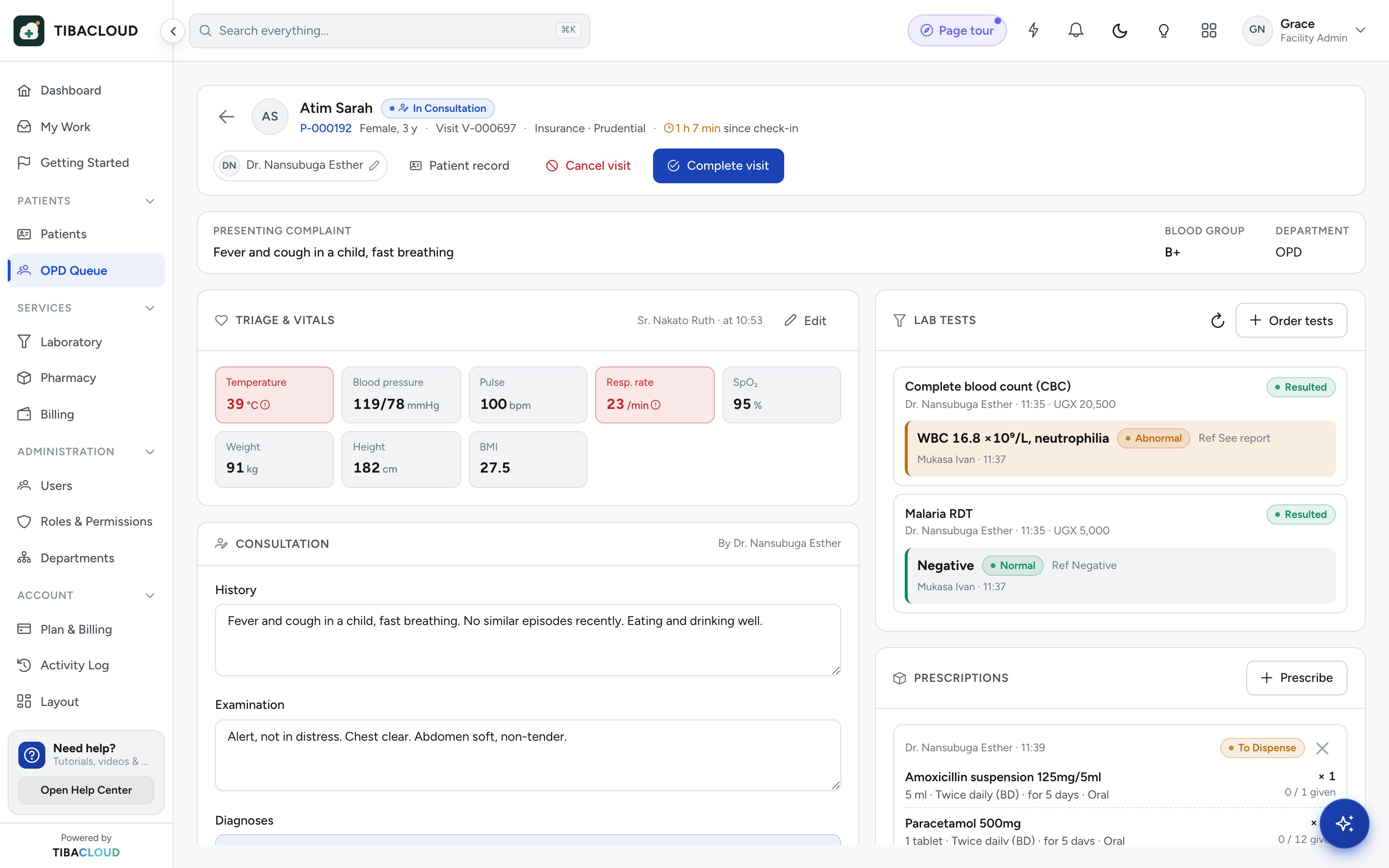
Each diagnosis is coded in ICD-11 during the consultation, and each visit records age and sex at registration. The monthly report adds them up, so nothing is counted twice or missed.
- Attendance by age and sex
- New and repeat attendances
- Top diagnoses from ICD-11 codes
Review and submit
Validate, review, submit
The report moves from generated to reviewed to ready to submit. Validation shows errors and warnings to review, and the data is mapped to the DHIS2 dataset for submission.
- HMIS 105 and 108 in Uganda
- MOH 705 and 711 in Kenya
- Validation errors and warnings
- Submission to DHIS2
Your country
National formats, set up for your country
Reporting is configured for the country you work in, and other national formats work the same way. Tax e-invoicing, such as URA EFRIS in Uganda or KRA eTIMS in Kenya, is supported where required.
- Included in every plan
- Confirmed for your country at the site visit
- Confirm tax obligations with your accountant
Facility settings
Country integrations
- On
Mobile money
MTN MoMo · Airtel Money
- On
Insurance
Private insurers and smart-card schemes
- On
National reporting
HMIS 105 / 108 → DHIS2
- On
Tax e-invoicing
URA EFRIS (where required)
- On
Data protection
Data Protection and Privacy Act 2019
National health insurance is not in force yet in Uganda; TibaCloud is ready to connect when it launches.
National reports
Everything the records office needs
Monthly national reports
Generated from registrations, visits, diagnoses and admissions.
ICD-11 based counts
Disease counts read from the diagnosis codes doctors enter.
Age and sex breakdowns
Attendance split into the age bands the form asks for.
Validation checks
Errors and warnings shown before you submit.
DHIS2 submission
Data elements mapped to the national DHIS2 dataset.
Country formats
e.g. HMIS 105/108 in Uganda and MOH 705/711 in Kenya.
Tax e-invoicing
Where required, e.g. URA EFRIS in Uganda and KRA eTIMS in Kenya.
Free updates
Forms updated as national reporting rules change.
See national reports running on your own workflow
Every plan, including Pharmacy.
National reports: questions
Does TibaCloud produce ministry of health reports?
Yes. Monthly national reports are generated from your records, for example HMIS 105 and 108 in Uganda and MOH 705/711 in Kenya, submitted to DHIS2. National reporting is included in every plan.
What is DHIS2?
DHIS2 is the open-source health information platform many ministries of health use to collect facility reports, including Uganda’s national HMIS and Kenya’s KHIS. TibaCloud maps its report data to the DHIS2 dataset so it can be submitted.
What are the HMIS 105 and HMIS 108 reports?
They are Uganda’s monthly facility reports to the Ministry of Health: HMIS 105 covers outpatient services and HMIS 108 covers inpatient services. TibaCloud builds both from the records kept during the month.
Does TibaCloud support EFRIS or eTIMS e-invoicing?
Tax e-invoicing such as URA EFRIS in Uganda or KRA eTIMS in Kenya is supported where required. Whether it applies to your facility depends on your tax position, so confirm your obligations with your accountant.
We are not in Uganda or Kenya. Can we still use national reporting?
TibaCloud works in any country, and national reporting is configured per country. We confirm which formats are available for yours during the site visit and quote.